
CM Punjab Scheme Eligibility Criteria 2026: Who Can Apply?
Are you searching for the CM Punjab Scheme Eligibility Criteria to find out whether you qualify for government assistance in 2026? The Government of Punjab offers different programmes for students, farmers, business owners, low-income families, and other eligible residents.
These initiatives provide different types of support, including educational scholarships, business financing, housing assistance, agricultural loans, and other welfare benefits. However, every scheme has its own eligibility requirements, application process, and selection conditions.
In this guide, you will learn about the general CM Punjab Scheme Eligibility Criteria, requirements for popular government programmes, necessary documents, and how to check whether you qualify before applying.
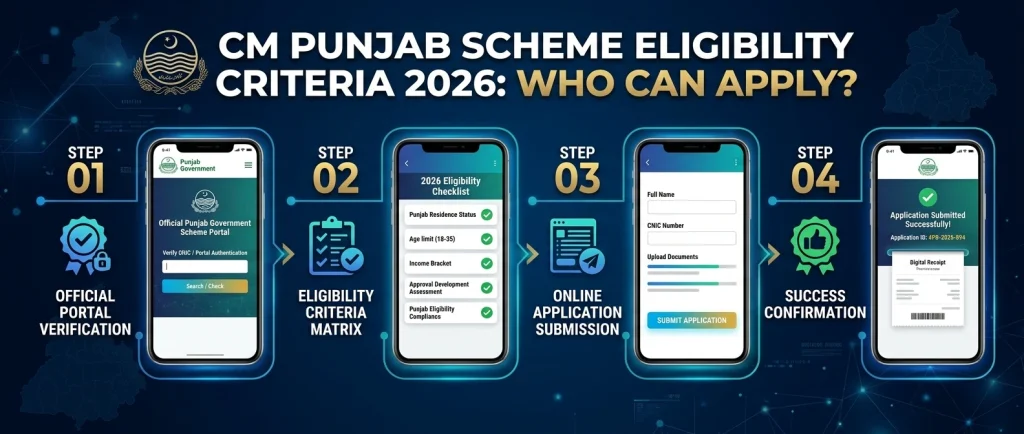
What Are CM Punjab Scheme Eligibility Criteria?
CM Punjab Scheme Eligibility Criteria are the rules and conditions applicants must meet to receive benefits under a particular Punjab government programme.
These requirements help the relevant departments identify eligible applicants and verify their information before approving applications.
Depending on the scheme, eligibility may be based on:
- Punjab residency or domicile.
- Valid CNIC or other identification.
- Age requirements.
- Household income or financial condition.
- Educational qualifications.
- Land ownership or agricultural records.
- Business ownership or business plans.
- Disability or other specific circumstances.
- Additional verification by government departments.
Important: Meeting general eligibility conditions does not guarantee approval. Final selection depends on the specific scheme’s official rules, verification process, available quota, and application requirements.
General CM Punjab Scheme Eligibility Criteria 2026
Although different programmes have different rules, applicants may need to meet some common conditions.
1. Punjab Residency
Many provincial government programmes require applicants to be residents of Punjab. Some schemes specifically require a valid Punjab domicile, while others verify residency through CNIC information.
Always check the residency conditions of your selected programme.
2. Valid CNIC
Applicants may need a valid Computerised National Identity Card issued by NADRA.
For student programmes or applications involving minors, additional identification documents may be accepted according to the official instructions.
3. Age Requirements
Certain schemes have minimum and maximum age limits. For example, business financing programmes may have different age requirements from student scholarships or welfare initiatives.
Do not assume that the same age limit applies to every CM Punjab scheme.
4. Income and Financial Conditions
Some welfare and housing programmes target low-income households. Applicants may need to provide income information or undergo financial verification.
Other programmes, such as business financing, may evaluate repayment capacity and credit history instead.
5. Educational Qualifications
Scholarships and student support programmes may require applicants to be enrolled in an eligible institution and meet specific academic requirements.
These conditions may include marks, academic performance, semester, degree programme, and institution eligibility.
6. Land or Agricultural Records
Farmer support programmes may require verified land ownership, agricultural records, and a mobile SIM registered against the applicant’s CNIC.
The exact landholding limits depend on the agricultural scheme and its current phase.
7. No Previous Financial Default
Some loan programmes check applicants’ credit history and outstanding financial obligations.
Applicants with overdue loans or unsatisfactory credit records may not qualify under certain financing programmes.
CM Punjab Scheme Eligibility Criteria for Different Programmes
The following examples explain how eligibility differs between major Punjab government initiatives.
1. Apni Chhat Apna Ghar Scheme Eligibility
The Apni Chhat Apna Ghar Programme is designed to support eligible low-income families who want to construct their own homes.
According to the Punjab government’s published programme information, important eligibility conditions include:
- Applicant must be the head of the nuclear family according to NADRA records.
- Applicant must be a permanent resident of Punjab according to CNIC.
- Applicant must be the sole owner and possessor of a plot measuring up to 5 Marla in urban areas or up to 10 Marla in rural areas.
- The plot must be intended for construction of the applicant’s house.
- Applicant must not have a qualifying criminal conviction under the programme’s rules.
- Applicant must not be a loan defaulter of a financial institution.
- Applicant must be registered in NSER with a household PMT score of 60 or less.
These conditions should be checked against the latest programme instructions before applying.
Official information: Apni Chhat Apna Ghar Programme
2. CM Punjab Asaan Karobar Card Eligibility
The CM Punjab Asaan Karobar Card provides interest-free business financing to eligible small entrepreneurs in Punjab.
The published eligibility requirements include:
- Applicant must be a Pakistani national residing in Punjab.
- Age must be between 21 and 57 years.
- Applicant must have a valid CNIC.
- Mobile number must be registered in the applicant’s own name.
- Existing or proposed business must be located in Punjab.
- Applicant must have a satisfactory credit history.
- Credit and psychometric assessment must be satisfactory.
- Only one application is allowed per individual and business.
The programme also has business verification and other financial conditions.
Official information: CM Punjab Asaan Karobar Card
3. CM Punjab Kissan Card Eligibility
The CM Punjab Kissan Card is designed to provide agricultural financing to eligible farmers for purchasing farming inputs.
Published programme information lists these important conditions:
- Applicant must be a farmer with eligible agricultural landholding.
- The published initial programme criteria specify landholding up to 12.5 acres.
- The farmer’s land record must be available in the Punjab Land Records Authority system.
- Mobile SIM must be registered against the farmer’s own CNIC.
- Applicant must complete the required verification process.
The Agriculture Department may revise landholding limits, loan amounts, and other conditions in later phases. Check the current phase before applying.
Official information: CM Punjab Kissan Card Scheme
4. Honhaar Scholarship Eligibility
The Honhaar Scholarship Programme supports eligible students pursuing higher education.
Students should check the latest official announcement for requirements such as:
- Enrolment in an eligible university or educational institution.
- Eligible degree programme and academic year.
- Required academic performance.
- Applicable domicile or residency conditions.
- Household income or other financial conditions, where specified.
- Submission of accurate academic and personal information.
Eligibility may differ by scholarship phase and participating institution. Students should not rely on older admission or merit criteria without checking the current announcement.
Official information: Punjab Higher Education Department – Honhaar Scholarship
Documents Required for CM Punjab Schemes
Applicants may need different documents depending on the programme.
Here is a general checklist of documents that may be requested:
| Document | Purpose |
|---|---|
| CNIC | Identity verification |
| Punjab domicile | Residency verification, where required |
| Registered mobile number | Application updates and verification |
| Passport-size photograph | Applicant identification, if requested |
| Income certificate | Financial eligibility, where applicable |
| Educational certificates | Student programme verification |
| Land ownership documents | Farmer or housing scheme verification |
| Property details | Housing programme requirements |
| Business information | Business financing applications |
| Bank details | Financial transactions, if required |
This is a general list, not a mandatory document list for every scheme. Upload only the documents requested by the relevant government portal.
How to Check Your CM Punjab Scheme Eligibility Online
If you want to apply for a government programme, follow these steps to check your eligibility.
Step 1: Choose Your Scheme
First, identify the programme that matches your needs.
For example:
- Students can explore scholarship programmes.
- Farmers can check agricultural support initiatives.
- Entrepreneurs can explore business financing.
- Eligible homeowners can review housing assistance.
- Deserving families can check relevant welfare programmes.
Step 2: Visit the Official Website
Open the official portal of your selected scheme or the relevant Punjab government department.
Check that the website address is genuine before entering your personal information.
Step 3: Read the Eligibility Requirements
Find the eligibility section and carefully review the age, residency, income, education, landholding, or other applicable conditions.
Step 4: Prepare Your Documents
Collect the documents required for the programme. Make sure your CNIC, mobile number, and other information are accurate.
Step 5: Complete the Application
If registration is open, fill out the application form using the official instructions.
Review all information before submitting your application.
Step 6: Save Your Application Details
Keep your application number, registration confirmation, or receipt if provided by the system.
You may need these details to check your application status later.
How to Check CM Punjab Scheme Application Status
After submitting an application, you may want to know whether it has been received, verified, approved, or rejected.
The status-checking process depends on the selected programme.
Generally, you should:
- Visit the relevant official registration portal.
- Find the application tracking or status section, if available.
- Enter your application number or other requested information.
- Complete any verification step.
- Review the status displayed on the portal.
- Follow official instructions if additional documents are required.
Some programmes use SMS notifications, helplines, or department offices instead of online tracking.
Remember that application submission does not automatically mean approval. Your information may still need verification.
Reasons Why an Applicant May Be Ineligible
An application may be rejected or declared ineligible for several reasons.
Common possibilities include:
- Applicant does not meet the minimum age requirement.
- Applicant does not fulfil the residency or domicile condition.
- Household income exceeds the programme’s permitted limit.
- Educational qualifications do not match the scholarship requirements.
- Land records cannot be verified.
- CNIC or mobile number information is incorrect.
- Applicant has an outstanding loan default under applicable financing rules.
- Required documents are missing or incomplete.
- Applicant does not meet additional programme-specific conditions.
If your application is rejected, check the official reason and follow the relevant department’s instructions. Do not submit false information to qualify.
Official Websites to Check CM Punjab Scheme Eligibility
Always use official government resources to verify scheme requirements and application announcements.
| Government Resource | Purpose |
|---|---|
| Chief Minister Punjab Office | Government announcements and initiatives |
| Punjab Government Portal | Provincial programmes and information |
| Agriculture Department | Farmer support programmes |
| Higher Education Department | Scholarship information |
| Apni Chhat Apna Ghar | Housing programme information |
Different schemes may have separate registration portals. A general government website may provide information without accepting applications directly.
Frequently Asked Questions (FAQs)
1. Who is eligible for CM Punjab schemes in 2026?
Eligibility depends on the selected programme. Students, farmers, entrepreneurs, low-income households, and other applicants may qualify if they meet the relevant official conditions.
2. Is a Punjab domicile necessary for every CM Punjab scheme?
Not necessarily. Some schemes require a Punjab domicile, while others verify residency through CNIC or use different eligibility conditions. Check the specific programme rules.
3. Can students apply for CM Punjab schemes?
Yes. Eligible students may apply for educational programmes such as the Honhaar Scholarship if they meet the academic, institutional, and other published requirements.
4. Can farmers apply for CM Punjab government schemes?
Eligible farmers can explore agricultural programmes such as the CM Punjab Kissan Card. Land records, CNIC verification, and other conditions may apply.
5. Is CNIC necessary for CM Punjab scheme registration?
A valid CNIC is required for many adult applicants. However, student programmes and applications involving minors may have additional identification requirements.
6. How can I check whether I qualify for a CM Punjab scheme?
Visit the scheme’s official website, read its eligibility criteria, and compare your information with the published requirements.
7. Can I apply for more than one CM Punjab scheme?
This depends on the rules of each programme. Some schemes allow applications independently, while others may have restrictions or conditions that affect eligibility.
8. Does meeting the eligibility criteria guarantee approval?
No. Applicants may still need to pass document verification, credit assessment, merit selection, a ballot, or other programme-specific checks.
9. Are all CM Punjab schemes free to apply for?
Not necessarily. Some programmes may have authorised processing fees or other charges. Always check the official instructions and avoid paying unauthorised agents.
Conclusion
Understanding the CM Punjab Scheme Eligibility Criteria is an important step before applying for any government programme in 2026. Different schemes support different groups, including students, farmers, entrepreneurs, homeowners, and deserving families.
Before submitting an application, check the official eligibility requirements, prepare the necessary documents, and confirm that registration is open. Use the relevant government portal to avoid fake websites and misleading registration offers.
Meeting the published eligibility conditions is essential, but final approval depends on the programme’s verification and selection process.